
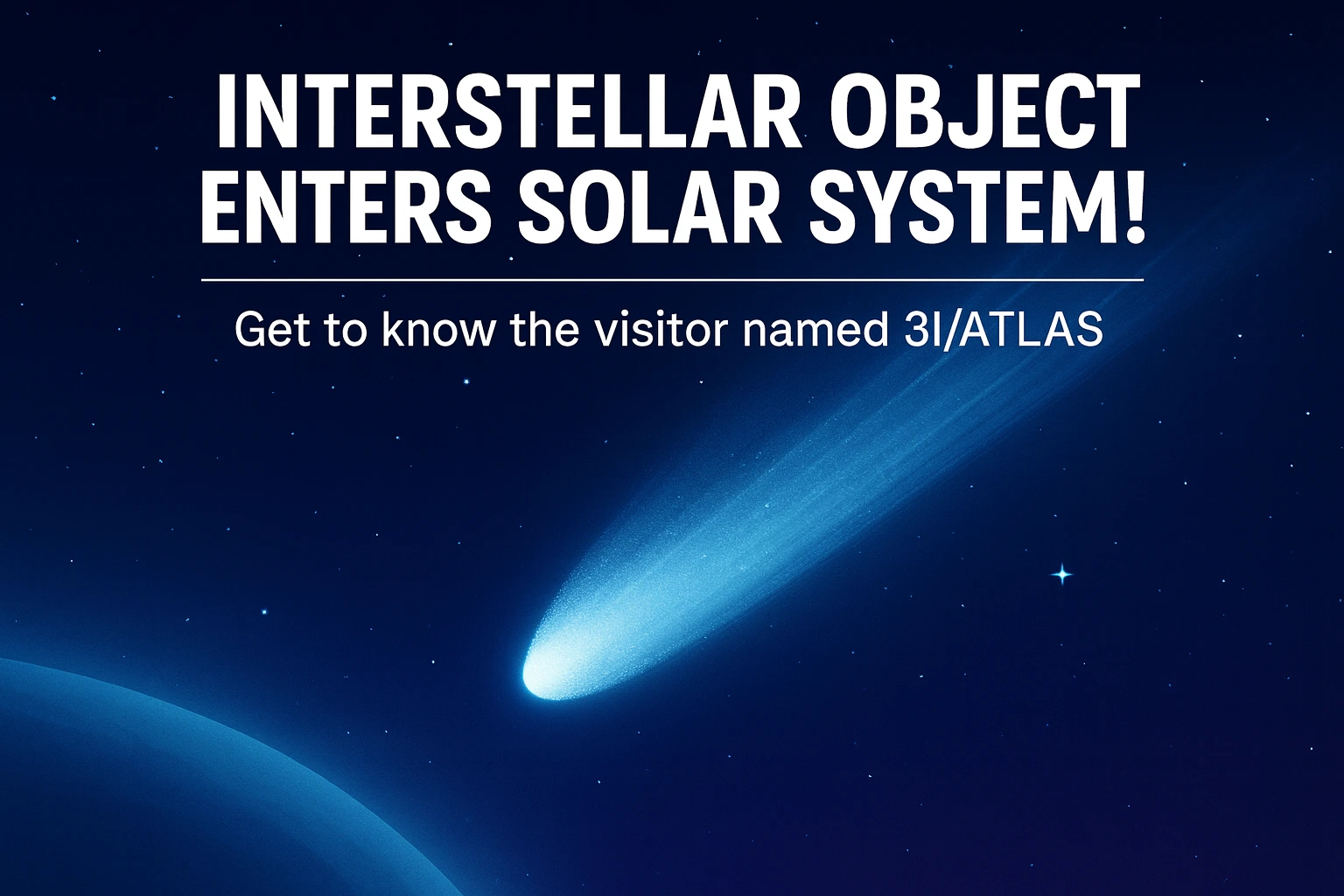
Guess who’s stopping by for a cosmic road trip? No, it’s not your in-laws from out of town — it’s a brand-new interstellar object cruising through our solar system!
Say hello to 3I/ATLAS, only the third known interstellar object to swing by our neighborhood. If you’re a space nerd (or just like shiny things in the sky), this is pretty exciting stuff.
Wait, How Rare is This?
Up until 8 years ago (that would be 2017) no official sightings of anything outside of our solar system were cited. Then, out of the blue (or out of the dark rather) came Oumuamua, that weird cigar-shaped rock that had scientists scratching their heads. A couple of years after that, comet Borisov came zipping through.
Now, here we are with 3I/ATLAS, officially the third guest from beyond. Pretty exclusive party, right?
Where Did it Come From?
Well, if you trace 3I/ATLAS’s path backward, it basically points toward the center of the galaxy. That’s right — this cosmic traveler may have started its journey millions (or even billions) of years ago, kicked out of its original star system by some gravitational mischief.
It’s been drifting through interstellar space ever since, until — by pure cosmic luck — it wandered into our solar system.
How Fast is This Thing?
Well, currently, it’s moving at a cruising speed of 130,000 miles per hour relative to the sun. The average speed of comments that we can see ranges from 22,400 to 156,000 mph, and that’s just for the ones close to use. The ones that cross our orbit. That’s fast enough to make your morning commute seem even sadder than usual. And it’s still speeding up as the sun’s gravity pulls it in.
As for its location, it’s hanging out between the asteroid belt and Jupiter at the moment. By late October, it’ll swing inside Mars’s orbit for its closest pass to the sun. But don’t worry — it’s not going to turn into a sci-fi disaster movie. At its closest to us, it’ll still be 160 million miles away.
Can You See It?
You actually might. If you have at least a decent backyard telescope and know where to look, you might be able to catch it. It’s actually brighter than Oumuamua or Borisov, which means amateur astronomers are already geeking out.
The brightness isn’t from the rocky surface itself but from a fuzzy cloud of gas and dust called a coma. Think of it like the comet’s glamorous, glowing hairdo or it’s halo. The actual solid part that’s underneath all that gas is probably much smaller than its glow suggests.
So… Aliens?
We know what you’re thinking. “Is it an alien spaceship?!” Let’s just say: probably not. But why should that stop people from wildly speculating online? We need to have some fun every now and then after all.
Harvard’s Avi Loeb (yes, the same guy who suggested Oumuamua might be an alien probe) has already started asking questions about its unexpected brightness. Still, most scientists agree this is likely just a comet minding its own business after being booted from its original solar system.
Fancy a Spin Through the Galaxy?

If your imagination is already soaring beyond the stars at this point, you might want to check out Alien Wins.
Get ready to blast off with:
- Morphing Wilds (Spaceships) — These land on reels 2, 3, or 4, expand to fill the reel, lock in place, and trigger a re-spin. Each new Wild during re-spins means more locked reels and even more chances to win.
- Massive multipliers — Every Wild comes with a random multiplier up to x8, and if you land multiple multipliers, they stack together for cosmic-sized payouts.
- Bursting Wilds feature — Randomly triggered to add 1–3 Wilds to reels 2, 3, or 4 after a spin or re-spin.
- Cosmic Spins option — Feeling brave? Activate this mode to guarantee Wilds on the reels every spin (for a higher bet), pushing your luck into another dimension.
With a top award of up to 50,000x your bet per line, high volatility thrills, and a colorful crew of mischievous extraterrestrials cheering you on, Alien Wins is pure space-age fun. Has there been a better time to reach for the stars and also check them out?
What’s Next For 3I/ATLAS?
Astronomers around the world will keep a close eye on it for months. It’ll remain visible to large telescopes well into next year. Scientists will study its composition, analyze the light bouncing off its coma, and maybe even figure out exactly what it’s made of.
Future instruments like the Vera C. Rubin Observatory in Chile will help us catch even more of these cosmic drifters before they crash the party. Before 2017, we didn’t know we had any interstellar visitors at all — now we’re starting to see them more often.
Final Thoughts
Even though 3I/ATLAS isn’t dropping in for dinner (or crashing into Earth), it’s still an awesome reminder of just how big and weird our universe is.
So if you get a clear night, point your telescope (or your imagination) toward the stars and give a wave. Who knows how long this little icy traveler has been out there waiting for someone to say hello?
After all, space is the ultimate surprise guest list — and you never know who (or what) will show up next.