

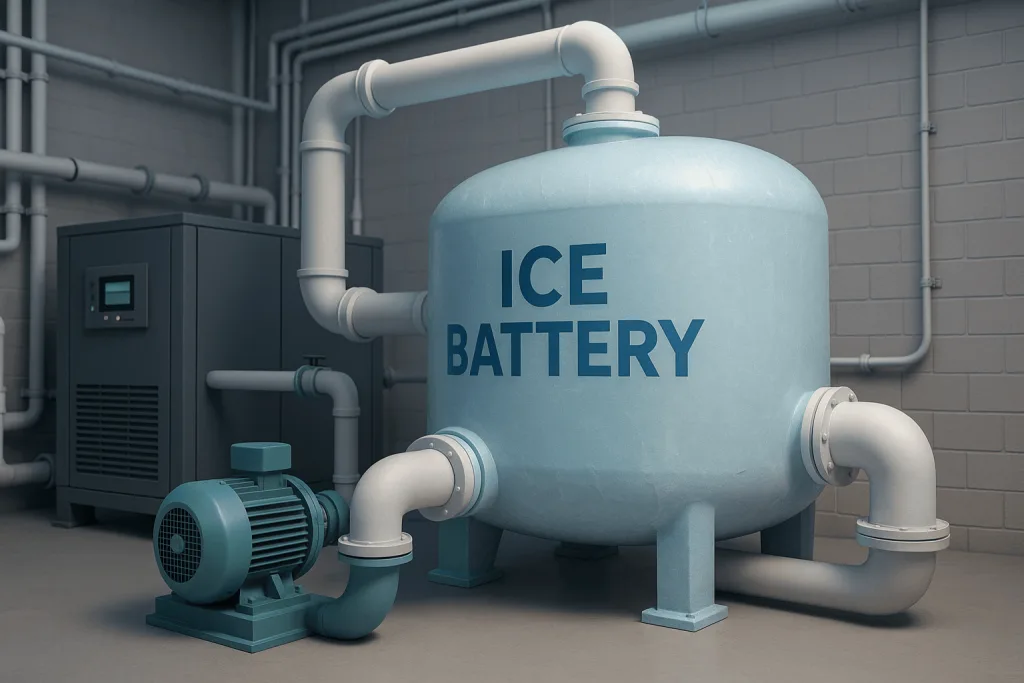
Think of hospitals that freeze their water not to preserve vaccines but in anticipation of cooling patients the next day. Each night, 27 tanks free about 74,000 gallons (≈280,000 liters) of water to ice-like temperatures. During the day, this ice melts to cool the hospital air to safe temperatures for surgeries and comfort of patients: the next day.
So-called ice batteries or thermal energy storage systems slowly gain property in the U.S. as energy-efficient means of lower-cost cooling for buildings and less pollution. Here’s how they work and why it matters.
Ice Magic
At the core, the idea is elegantly beautiful yet deceptively simple.
1. Freeze during off-peak hours when the electricity is cheaper (generally at night).
2. Retain cold in huge tanks.
3. Use the ice the next day to cool water running through the building, absorbing heat in the process.
4. Thawing does the cooling-no additional energy is used to “make cold” during peak hours.
So, by shifting energy use to off-peak times, it is thereby alleviating strain on the power grid during hot daytime peaks. This company is so advantageous that it lowers peak demand charges and really helps in smoothening energy use.
At Norton, the ice-cooling system cooperates with or even allows conventional HVAC systems to be downscaled.
Dollars, Sense, and Sustainability
Add money and environmental benefits to the argument in favor of this system. After its switch-over, the hospital saw savings of nearly $278,000 on its power bills in the first year. With that and some other energy efficiency upgrades, the hospital estimates savings of almost $4 million over the years.
The ice battery also stands in good stead for lowering the obligatory use of fossil fuel power stations during peak hours, which could be the most polluting ones, especially on a hot afternoon when grids are at their limit. The cool without adding to greenhouse gas emissions or refrigerants that could lead them.
Given that cooling can comprise roughly 20% of a building’s electricity consumption, moving that load around smartly can make a big difference. Some comparisons show savings of 30-40% during peaks depending on local conditions, design, and usage patterns when compared to traditional systems.
The Fit for This Technology
Ice battery solutions are not for everybody, but they can work wonders in certain types of buildings:
- Where cooling mechanisms are critical to life safety and fire protection; as in hospitals and health care institutions. In this respect, ice is safer compared to heavy lithium batteries.
- Buildings requiring heavy cooling during the daytime like commercial, offices, educational, and government buildings.
- Data centers-illegally requiring constant cooling and already power-hungry. Some ice battery companies want to target them as a prime source.
- The downside is that it becomes mostly useless in climates where they don’t need cooling most of the time or when the price difference between peak and off-peak power is.
In any case, ice batteries are coming into their own with electricity grids under increasing strain, rising temperatures, and a growing demand for reduced carbon footprints.
IC Wins
If getting an ice battery isn’t an option for you, we’ve got the next best thing to help you stay cool. IC Wins brings ice winds to you wherever you may be and no matter the heat! It’s a snow adventure that brings a nice chill while simultaneously warming your heart and hopefully filling your wallet.

What makes IC Wins a nice pick:
IC Wins brings a frosty adventure that’s packed with warmth, surprises, and a flurry of winning potential.
- 4,096 Ways to Win – Forget traditional paylines; this setup means countless chances to strike gold in the snow.
- Guaranteed Re-Spin Wins – Lost a spin? No worries! A random losing spin can trigger a Re-Spin that guarantees a win, complete with a random multiplier up to 7x.
- Campfire Wilds – The Wild symbol (a warm campfire) substitutes for everything except the Scatter, helping you melt away the cold streaks and land combos.
- Free Games Feature – Landing 3 or more Scatter logos triggers up to 16 Free Games. During these rounds, every spin carries a random multiplier between 1x and 7x, giving you that perfect mix of anticipation and excitement.
- Big Wins Await – With a top award of 226,800, you’ll be saying “IC Wins!” before the snow settles.
IC Wins brings a frosty adventure that’s packed with warmth, surprises, and a flurry of winning potential.
The Bigger Picture: Grid Stability & Future Coolants
What makes ice batteries really exciting is that they work not just for one building but for the entire energy system. Multiple buildings using them reduce peak demand and smooth out electricity use curves, hence improving grid stability.
They also nicely complement renewable energy sources. At night, when solar is off, buildings can freeze water with cheap electricity or excess wind generation. In the daytime, when solar peaks, the ice does the cooling as demand rises. Tying this strategy to solar power helps retire fossil fuel backup plants.
Newer designs are even chunkier. Companies have started marketing modular “Ice Bricks” or slim systems to penetrate the smaller building sector or retrofitting.
Another line of investigation: Researchers are developing smart control systems for forecasting cooling demand and optimizing freeze or thaw timing to extract more efficient ghost from this system. A recent study achieved almost 10% further savings by modifying schedules around midday on a basis of load predictions.
Final Word
Norton Audubon Hospital’s leap into ice-based cooling is more than a trick – it is a roadmap for how infrastructure can transform in a warming world.
Freezing water at night, then using it to cool during the hottest hours-an elegant strategy extracting costs and emissions from peak times. It is not a perfect fit for every building or climate, but for hospitals, offices, data centers, and other voracious buildings, it’s proven to be a smart play.
With improved controls, smaller systems, and increasing demand, ice batteries could soon fade away from the novelty tech world and become a commonplace feature in sustainable building design.