
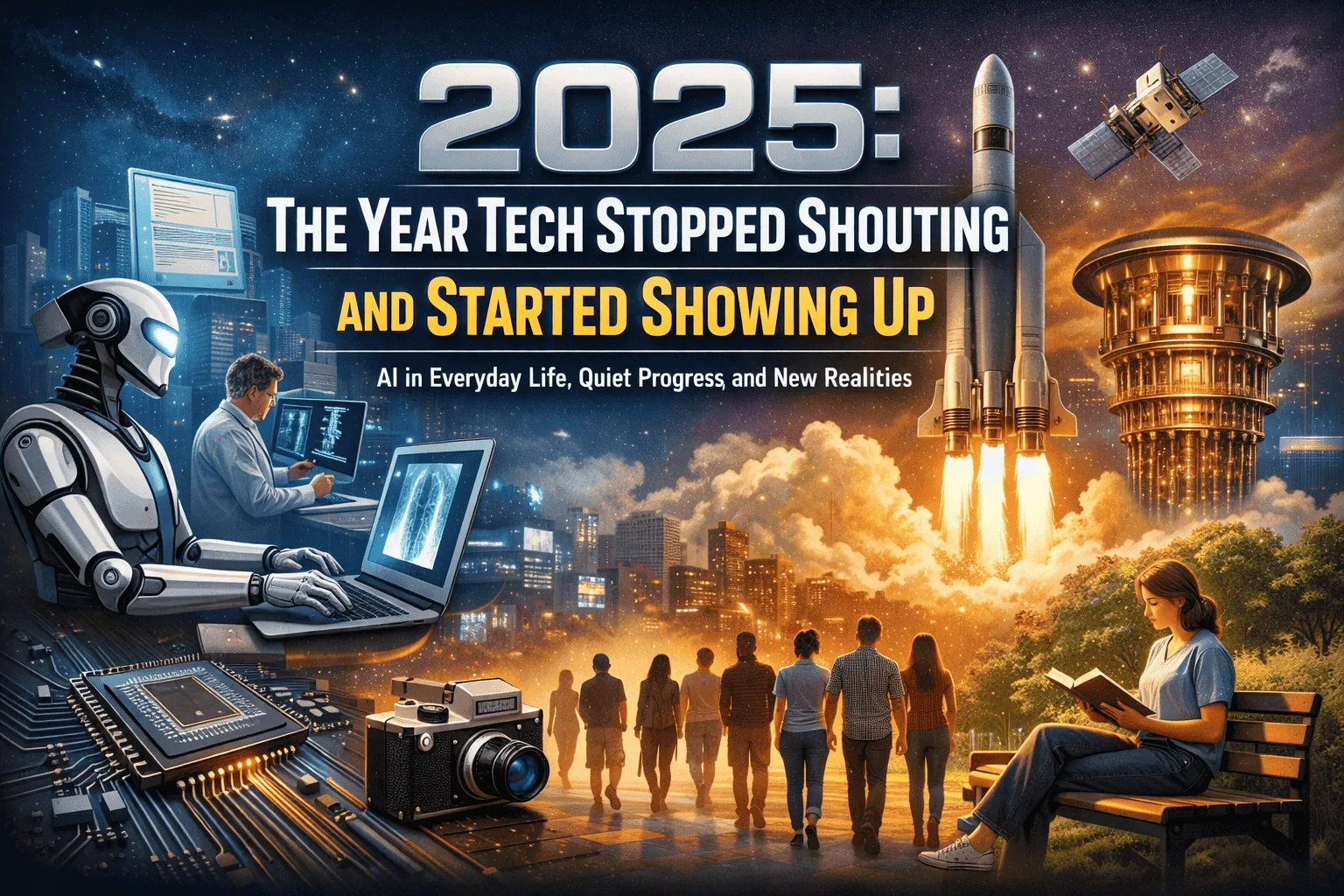
For years, we were told the digital revolution would eat itself alive. That artificial intelligence would take everyone’s jobs, break society, or somehow collapse under its own hype. None of that really happened in 2025.
What did happen was quieter and more interesting.
This was the year technology stopped shouting about the future and started showing up in everyday life.
AI Finally Left the Demo Stage
In 2025, artificial intelligence stopped feeling like a tech demo and started feeling like infrastructure. It wasn’t something you had to seek out. It was just… there. In offices, hospitals, creative work, logistics, search engines, even public services.
AI wrote drafts, sorted data, sped up research, helped doctors double-check diagnoses, restored ancient artwork, and quietly improved things like weather forecasts. None of it felt magical anymore. It felt practical. And that shift mattered.
For all the talk about AI replacing humans, the reality turned out to be far less dramatic. Most jobs didn’t disappear. They changed. Routine tasks faded into the background. Creative, strategic, and human judgment became more valuable. People didn’t get replaced — they got new tools and new expectations.
Of course, it wasn’t all smooth.
Anyone who actually worked with AI in 2025 knows the frustration. The answers that are almost right. The confident mistakes. The weird hallucinations. The feeling that you still need to double-check everything. Developers complained. Writers rolled their eyes. Artists pushed back, especially around copyright and ownership.
Even Hollywood drew a line in the sand.
The mood shifted from blind excitement to cautious realism. AI wasn’t a miracle. It was powerful, flawed, and very much unfinished.
Joining Extreme

You don’t have to invest before you are certain you like our games. So why don’t you start off with our Free Welcome Bonus? With it you can check out the games, see how much fun year having, all the while having a chance to walk away with some real money in your pocket. Then when you decide you want to play in the big leagues you can check out our Promotions page for some serious bonuses.
How the Welcome Bonus works:
- The bonus is only available as the very first action on your account
- Maximum withdrawal: $50
- Eligible on non-progressive slots (excluding 777)
- Limited to one use per player, household, or IP address
- Standard terms & conditions apply
The World Starts Setting Boundaries
By the middle of the year, governments started reacting. Especially in Europe, new rules focused less on what AI can do and more on what it should be allowed to do. Transparency, accountability, responsibility—words that hadn’t mattered much during the hype phase suddenly became central.
Investors also cooled down. After years of sky-high expectations, some started asking uncomfortable questions: Are we overbuilding? Are we overpromising? Could this all end in another tech winter?
No one had clear answers, but the tone had changed.
Tech Power Is No Longer One-Sided
Another big shift in 2025 had nothing to do with software—it was about power.
For the first time in a long while, American tech companies weren’t the only ones leading the conversation. Chinese AI models arrived faster, cheaper, and surprisingly competitive. Some were open source. Some performed on par with the best Western systems. That alone shook markets.
Behind the scenes, the real battle was happening in hardware. Chips, energy, manufacturing. China pushed forward on advanced chip technology long thought to be out of reach. New ideas emerged everywhere—analog chips, photonic chips, designs meant to use less energy instead of brute force.
It became obvious that the future of AI wouldn’t be decided by apps alone, but by who controls the machines underneath them.
Quantum Computing Stops Being a Sci-Fi Punchline
Quantum computing also had a solid year—not flashy, but meaningful. Researchers broke records for qubit counts. Big tech companies revealed ambitious architectures. No one’s buying a quantum laptop anytime soon, but the field crossed an important line: it started feeling real.
Slow, difficult, expensive but real.
Space Reminds Us Progress Is Hard
After multiple failed attempts, SpaceX finally pulled off a successful launch and landing of the most powerful rocket ever built. It wasn’t perfect. Parts overheated. Damage occurred. But the mission worked.
That moment captured something important about 2025: progress isn’t clean. It’s messy. It breaks. Then it moves forward anyway.
A Pushback Against Always-Online Life
While technology kept advancing, society pushed back in small but meaningful ways.
Australia became the first country to ban social media for children under 16. Other countries followed with discussions about phone-free schools, digital curfews, and limits on screen time. These weren’t anti-tech moves. They were course corrections.
A collective realization that not everything needs to be optimized, automated, or online.
Culture Felt Lighter—And That Matters
Oddly enough, pop culture in 2025 felt lighter than expected. Sports leaned into spectacle. Nostalgia packed stadiums. Viral trends came and went without constant outrage. It felt like people were, briefly, enjoying things again.
After years of tension, that mattered.
Looking Back
2025 wasn’t the year AI took over. It was the year we learned how to live with it. Technology didn’t save us. It didn’t destroy us either. It grew up—and so did our expectations.
And maybe that’s the healthiest place it’s been in a long time.