
A French court on last Thursday released a report sharply criticizing the Louvre’s management for prioritizing attention-grabbing art acquisitions and renovation projects over the basic security of one of the world’s greatest museums.
A bold daytime robbery, in which four men stole invaluable historical jewels, was a “deeply alarming warning,” said Pierre Moscovici, president of the French Court of Audit, which produced the report. You can find out more on the heist itself in our previous post.
He explained that the museum’s leadership favored “visible and attractive” projects. Such as art purchases and refurbishments—at the expense of other crucial areas, including security.
Since the theft, new information has surfaced showing that security lapses had been known for years. This includes a 2014 warning that one of the museum’s main passwords was simply “LOUVRE.” The new report adds to the list of security failures exposed by the heist.
What Went Wrong?
In just four minutes after arriving at the Louvre’s outer wall, the thieves climbed the building and entered through a window. The internal alarms only went off after they were already inside. Four minutes later, after smashing a reinforced glass display and taking nine pieces of historic jewelry, they were already escaping.
“The weaknesses in protecting our perimeter are known and identified,” Louvre director Laurence des Cars told the French Parliament after the theft.
The Situation Inside Wasn’t Much Better.
According to the report, in 2024 the Louvre had only 432 surveillance cameras for its 465 galleries, nearly 50% more than in 2019. And yet still leaving 61% of galleries without any video monitoring.
The Louvre, the world’s largest museum, spans about 60,600 square meters. For comparison, the Detroit Institute of Arts, which has a similar size (including a theater and concert hall), has more than 550 cameras, according to Axis data.
Des Cars told senators that she plans to double the number of cameras covering the Louvre’s 37-hectare grounds in the coming years.
In its recommendations, the Court of Audit emphasized that the Louvre must “strengthen its internal control functions, which remain underdeveloped for an institution of its size.”
Cybersecurity Failures
The Louvre’s security problems weren’t limited to the physical world. Digitally, the situation was just as poor.
A 2014 report by the French National Cybersecurity Agency (ANSSI), accessed by the newspaper Libération, revealed that the password for the server managing the museum’s surveillance system was simply “LOUVRE.” Access to the system maintained by Thales, the company responsible for the security infrastructure, was protected by an equally “impenetrable” password: “THALES.”
That same ANSSI report recommended that the Louvre improve its cybersecurity. They should also move away from outdated software that could compromise its safety systems.
ANSSI did not deny the findings but told CNN that the 2014 audit “cannot be considered representative of the Louvre’s current level of information-system security.”
Budget Priorities
The report also focused on the museum’s budget choices. Between 2018 and 2024, the Louvre spent about €27 million on maintenance and another €60 million on renovating the palace itself.
By contrast, twice that amount was spent on art acquisitions and exhibition renovations during the same period.
Over six years, the museum allocated €105 million to purchase 2,754 artworks.
In 2021, it paid around €5 million for two paintings by French Rococo artist Jean-Honoré Fragonard, and in April 2025 it bought an “exceptional” Fabergé triptych for €2.2 million.
Many of these acquisitions remain somewhat secretive, especially when it comes to pricing. The Court of Audit warned that the museum should be more cautious about the prices it pays for artworks—particularly when similar pieces had recently sold for less at auction.
Cash Bandits 3
And while it seems that these days robing the most well-known museum in the world is a walk in the park, get to these vaults is a different kind of game entirely.
Test your heist skills in this high volatility game and is if you can crack open the vaults!

These cunning safe breakers will help you along the way.
So here’s what Cash Bandits 3 has to offer.
Players can trigger the Vault Feature to unlock up to 390 free games with multipliers reaching x23, making every spin a high-stakes getaway. You get a shote at guessing the combination to the vaults. Even if you don’t open the main one you could still walk away with lots of free spins. The Robber Wild keeps the action fast-paced, while random Local Progressive Jackpots can strike at any moment for even bigger wins.
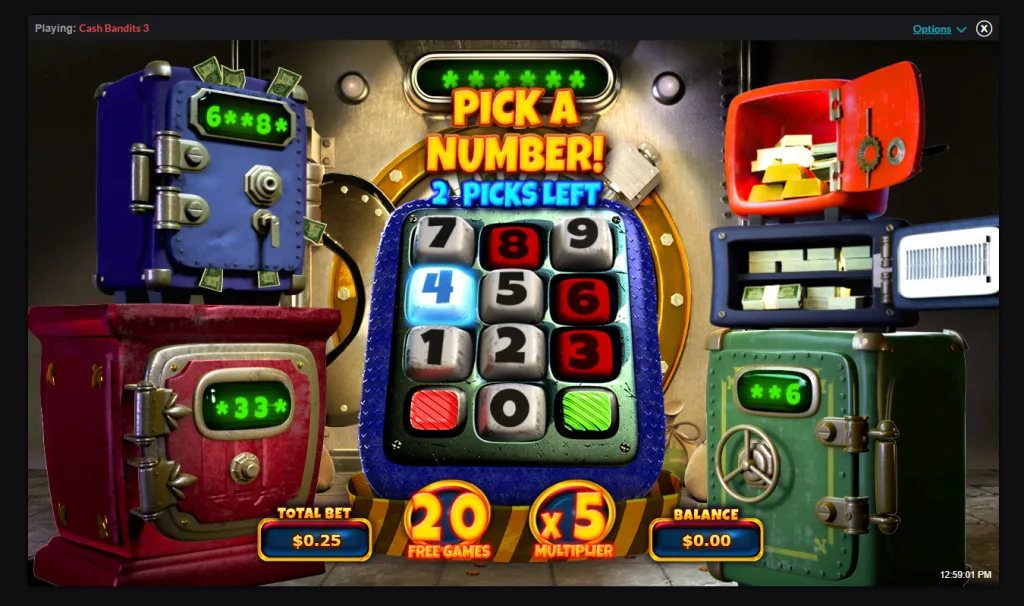
Game Highlights:
- 5 reels, 25 variable paylines
- Vault Feature with up to 390 Free Spins
- Multipliers up to x23
- Random Major and Minor Jackpots
- High volatility for adrenaline-filled play
Crack the code, spin the reels, and see if you can make your escape with the loot in Cash Bandits 3.
No One Fired
Despite the focus on high-profile, media-friendly projects, the report revealed shocking delays in improving the museum’s security infrastructure. Upgrades recommended back in 2015 are not expected to be completed until 2032.
The report covers nearly eight years of museum operations and the mandates of two different directors.
As of publication, no executives or staff members have been dismissed or resigned because of the theft.
Louvre director Laurence des Cars offered to resign, but Culture Minister Rachida Dati rejected the offer.
Dati — known in France as a “political bulldog” — strongly defended the museum after the October 19 robbery.
“Did the Louvre’s security measures fail? No, they did not. That’s a fact. The Louvre’s security measures functioned,” she told lawmakers on October 21.
A day later, President Emmanuel Macron called for an accelerated implementation of enhanced security measures at the museum.
By the following week, Dati softened her tone, telling senators that while the systems functioned and staff followed protocol “to the letter,” the “spectacular robbery” was clearly a failure for the museum.
“There were indeed security breaches,” she admitted.